
Industrial gas compression underpins critical operations worldwide, from generating clean energy, gas recovery, enabling medical breakthroughs to powering advanced global shipping fleets. Choosing the right compressor isn’t just about technical specifications. It’s about ensuring reliability, efficiency, safety, and long-term performance in demanding environments.
At Sauer Compressors, we bring decades of experience to this challenge. Our portfolio spans gases from A to Z in either oil-injected or oil-free solutions. In this guide, we’ll explore the key factors in selecting the right compressor, illustrated by real-world examples where Sauer solutions have proven themselves.
Key Factors to Consider
1) Gas Type
Different gases behave in very different ways, and compressors must be designed with these properties in mind:
- Chemical properties: Hydrogen, with its extremely small molecular size, demands leak-tight systems to prevent losses. Helium is non-corrosive but prone to micro-leaks through seals. Methane is flammable, requiring special materials and explosion-proof designs. CO₂ can form carbonic acid in the presence of moisture, making it highly corrosive under certain conditions.
- Potential risks: Corrosion, leakage, and contamination are all major hazards if the wrong compressor materials or designs are chosen. Using oil-lubricated compressors in sensitive gas applications, for example, risks contamination that can compromise processes and safety.
Case in point: Nuclear Medicine (HAUG.Pluto)
The isotope Technetium-99m is the most widely used radioisotope in nuclear medicine, critical for millions of diagnostic procedures worldwide. Its production requires extremely controlled conditions where even trace contamination could jeopardize the process. To enable research into new Tc-99m production methods, a Dutch company relies on three of Sauers oil-free HAUG Pluto compressors to provide zero-loss contamination-free helium cooling at high temperatures. By combining oil-free, hermetically sealed technology with proven reliability, Sauer’s compressors ensure safe and uncompromised gas handling, directly supporting advances in life-saving diagnostics for cancer and heart disease.
2) Pressure Requirements
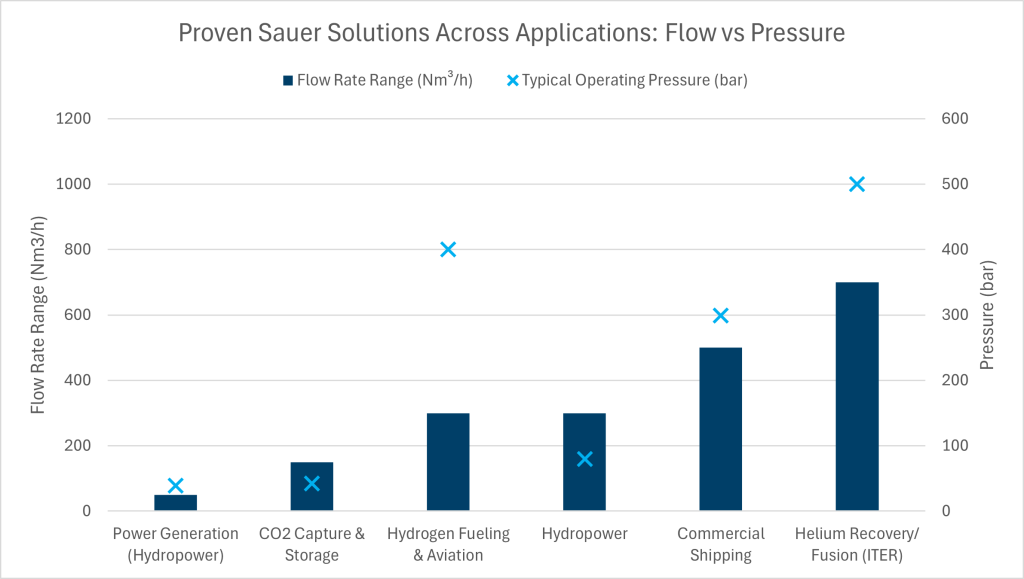
Pressure needs vary widely depending on the application, and selecting the right compressor means matching both the operating range and the durability required for continuous service.
- Application-specific needs:
Many processes require high-pressure compression; from 200–300 bar hydrogen fueling to 400+ bar gas recovery and pipelines. Medium-pressure applications up to 20 bar remain common in processing and utilities. - Challenges at high pressure:
Above 200 bar, compressors must manage gas-tight sealing, heat loads, and component wear, demanding advanced materials, cooling, and safety systems. - Sauer’s solutions:
Sauer covers the full spectrum, from medium-pressure units (≤20 bar) to heavy-duty models up to 500 bar, all engineered for continuous, precise, and safe operation.
Case in point: ITER Fusion Project
For the world’s largest fusion project, Sauer is building a helium recovery system to re-compress vast volumes of helium used to cool superconducting magnets. The system, five compressors on an 8×8 metre frame, is the largest Sauer system ever built, designed to operate reliably at scale in one of the most ambitious energy projects on the planet.
3) Flow Rate
Alongside gas type and pressure, flow rate is a critical factor in compressor selection. The flow capacity must match the operational demands of your process to ensure efficiency, minimize energy costs, and avoid unnecessary wear on the equipment.
- Operational demands:
Flow needs range from tens of Nm³/h in labs to hundreds of Nm³/h in shipping or hydropower. Under sizing risks downtime and process delivery; oversizing wastes energy and space. - Custom configurations:
Sauer’s modular designs allow cylinder adjustments or multi-unit setups to deliver the exact flow required without sacrificing efficiency.
Case in point: Commercial Shipping (LEVANTE Series)
Modern 22,000 TEU container ships require extremely high and continuous flow for starting air systems. Sauer’s LEVANTE series delivers up to 460 m³/h of air in a compact, three-stage design, tailored specifically for marine engine rooms. By combining high flow capacity with a space-saving layout, the LEVANTE shows how Sauer matches flow demands with real-world operational constraints.
4) Operating Environment
The conditions in which a compressor operates are often as important as the gas or pressure requirements. Compressors must be designed to withstand site-specific challenges while maintaining consistent performance.
- Ambient conditions: Extreme heat, cold, humidity, or dust can all impact reliability. Offshore installations face saltwater corrosion, while remote power stations may contend with unstable ambient conditions or limited maintenance access.
- Space constraints: Industrial and marine installations often have tight footprints, requiring compact designs without sacrificing output.
Case in point: Rusumo Hydropower (Rwanda)
When competitor compressors failed at 80 bar, the entire 80 MW Rusumo Hydroelectric Power Station was forced offline – affecting power supply across Rwanda, Burundi, and Tanzania. Sauer supplied two Passat WP66L units with control cabinets and had them running within days. This rapid response restored stable operation and highlighted the decisive role compressors play in national energy security.
5) Oil-Free vs. Lubricated Compressors
Before selecting a compressor, it’s essential to determine whether your process demands an oil-free system for purity or whether a lubricated model is sufficient for durability and cost efficiency.
- Oil-free compressors:
Essential for critical purity (medical oxygen, food-grade gases, pharma, hydrogen). They prevent contamination, cut filtration needs, and meet strict safety standards. - Lubricated compressors:
A robust choice for less sensitive uses (industrial air, natural gas) where oil carryover exists and can be reduced (but not fully eliminated) using downstream filtration. - Why it matters:
Using the wrong type risks contamination in sensitive applications or unnecessary costs in low-risk ones.
Case in point: Healthcare & Purity
Oil-free compressors like the HAUG series are trusted in hospitals worldwide to deliver contamination-free oxygen and nitrogen. Because nuclear medicine requires absolute purity, Sauers HAUG Pluto compressors deliver oil-free, contamination-free gas handling that protects the integrity of sensitive isotope production.
6) Compliance with Industry Standards
Compressors must meet stringent international standards (ASME, ISO, CSA, marine class approvals) to ensure safety and performance.
Case in point – Global Shipping (LEVANTE Series):
Sauer’s LEVANTE compressors were developed exclusively for marine applications and carry the necessary marine class approvals demanded by shipbuilders worldwide. Already installed on 22,000 TEU mega carriers from MSC and CMA CGM, the LEVANTE series combines compact, three-stage air-cooled design with certification-ready reliability. By meeting the strictest marine safety and performance standards, the LEVANTE not only ensures compliance but also supports next-generation LNG propulsion systems and Shipping 4.0 automation, proving how certified equipment underpins innovation in global shipping.
Key Compressor Applications in Canada
- ✅ Automotive & Manufacturing: Leak testing and precision processes require clean, oil-free compression.
Models: HAUG.Sirius, HAUG.Pluto - ✅ Gas Handling & Energy Transition: Hydrogen, helium, and CO₂ compression for storage, fueling, and processing.
Models: HAUG.Sirius NanoLoc, HAUG.Sirius HP 450, HAUG.Pluto - ✅ Oil & Gas: Offshore and onshore compression of methane and associated gases in hazardous environments.
Models: Sauer 6000 Series, Hurricane WP4351 BasSeal CNG - ✅ Power Generation & Distribution: Braking air, turbine control, and utilities.
Models: Passat WP66L, Tornado WP3215 - ✅ Commercial Shipping: Starting air and LNG propulsion for fleets.
Models: LEVANTE WP460L, WP320L Marine
Choosing the right compressor isn’t just about meeting technical specifications; it’s about ensuring efficiency, safety, and reliability across every industry. Whether in manufacturing, energy, healthcare, shipping, or processing, the right solution reduces downtime, lowers operating costs, and extends equipment life.
At Sauer Compressors Canada, we combine global expertise with proven technology to deliver compressors that perform in real-world conditions, from everyday industrial applications to the most demanding environments.
Contact us today to speak with our experts and find the ideal compressor for your application.
About Sauer Compressors Canada
Sauer Compressors Canada specializes in medium and high-pressure air and gas compressors for applications in general industry, petro-industry, commercial shipping, and the defense sector in the Canadian market.
Sauer Compressors are the global leader in the market for medium and high-pressure compressors, with pressures up to 7,000 psi, rated for continuous duty, and tested in the most demanding conditions to provide true 24/7 reliability. In addition to standard products, we offer customized solutions for our customers, OEMs, and companies that operate on a global stage.
For more information, please contact us at [email protected]